Most AI video pricing guides are written from San Francisco or London, for markets that behave nothing like ours.
I work as an in-house AI creative director for a major FMCG company in the Middle East. The ads I ship every week are made for MENA consumers — bilingual, culturally specific, and judged by regional retail buyers, not by a tech conference audience. So when a marketing director in Dubai, Riyadh, or Kuwait City asks me what an AI commercial should cost, I can answer from invoices, not estimates.
I’ve already published a global pricing breakdown. This article covers what’s different when your audience is in the Gulf and the wider MENA region — because three things genuinely change the math: agency rates, localization, and Ramadan.
What does an AI video ad cost for a Gulf brand right now?
The honest range in 2026: $1,500 to $10,000+ for professionally directed AI video, depending on scope and how many language versions you need. My own studio pricing:
| Package | Price range | What you get | Typical timeline |
|---|---|---|---|
| Spot | $1,500 – $2,500 | One cinematic 30–60s commercial + key visual | 4 – 7 days |
| Spot, bilingual (AR + EN) | $2,000 – $3,200 | Same spot, two full language versions with adapted supers and VO | 6 – 9 days |
| Campaign | $3,000 – $4,500 | 3 videos + poster + social assets | 2 – 3 weeks |
| Ramadan campaign | $4,000 – $6,500 | Hero film + cutdowns + key visuals, planned around the season | 3 – 4 weeks (book earlier) |
| Retainer | $2,000 – $3,500 / month | 4 – 6 deliverables per month for one brand | Ongoing |
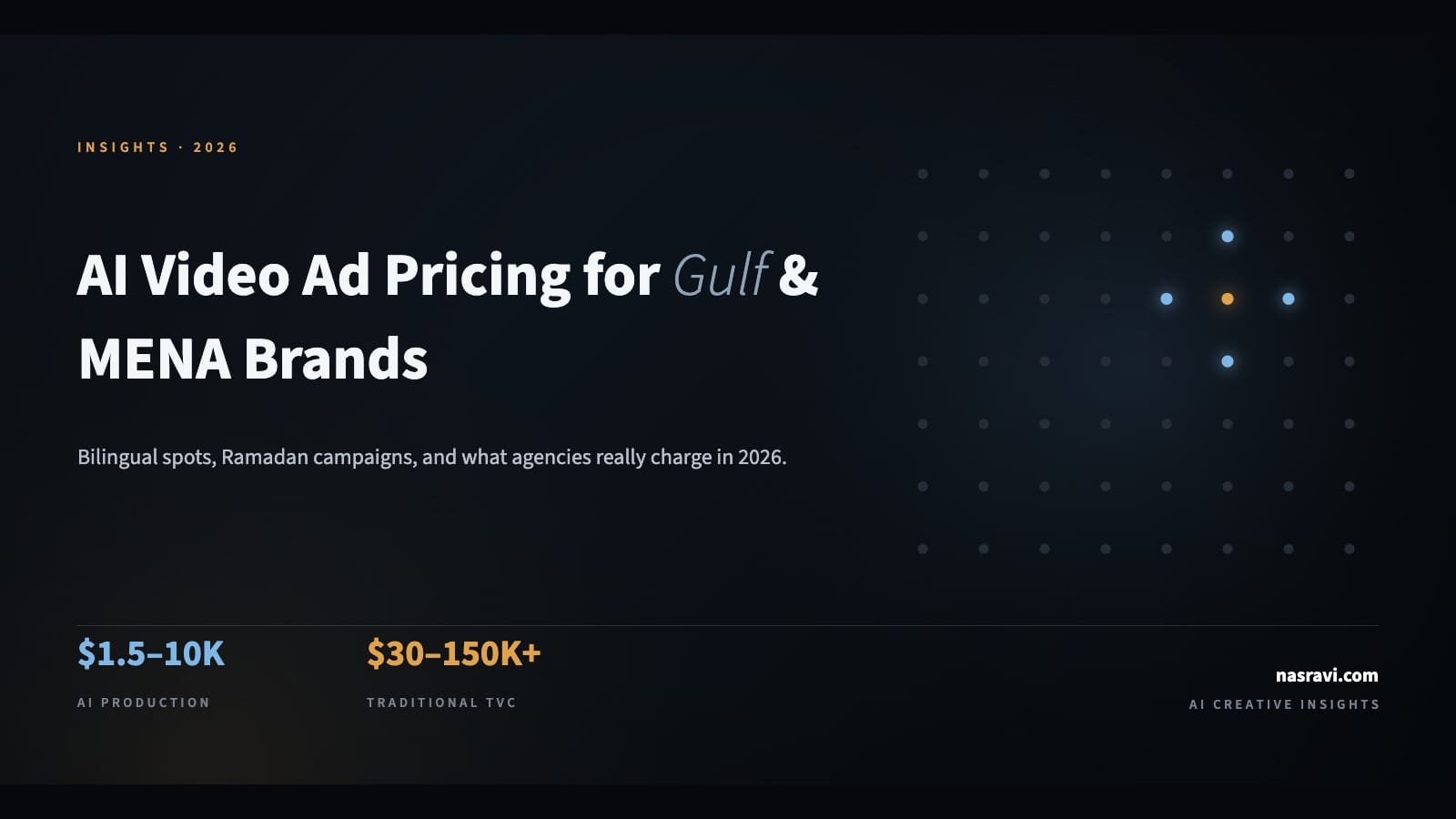
For context: a traditional 30-second TVC produced through a Dubai or Riyadh agency typically runs $30,000 to $150,000+ once you add crew, casting, location permits, and post-production — and celebrity-led Ramadan productions go far beyond that. The AI gap in this region is wider than in Europe or the US, because Gulf production costs sit at the premium end of the global market while AI production costs the same everywhere.
Why are Gulf agency quotes so much higher than global averages?
Three structural reasons, none of them scandalous.
First, talent and logistics are imported. Crews, directors, and equipment for premium shoots often fly in, and summer heat compresses the outdoor shooting calendar. Second, the market is used to prestige pricing: regional TVC culture was built on big Ramadan moments and cinema-grade craft, so quotes carry that legacy. Third, multi-market campaigns multiply everything — a GCC campaign traditionally means separate versions for Saudi, Emirati, and wider Khaleeji audiences, each with its own casting and approval loop.
AI production doesn’t magically delete those needs. It deletes the physical costs attached to them. Versioning for three Gulf markets no longer means three shoots; it means three direction passes on the same pipeline. In one of our FMCG projects, producing a second cultural version of a finished film took two days and roughly 15% of the original budget — traditionally, that’s a second production.
What does Arabic localization actually add to the budget?
Less than agencies charge, more than tool demos admit. Budget for four real cost lines:
- Arabic voice-over and casting. Good Khaleeji or MSA voice talent is worth paying for. AI voices have improved, but for brand films I still direct human VO or heavily supervised synthetic VO. Add $200 – $500 per version.
- Right-to-left typography and supers. Every on-screen text element is redesigned, not mirrored. Arabic type has its own rhythm; lazy RTL conversion is the fastest way to look foreign. Add 1 – 2 days of design time.
- Cultural direction. Wardrobe, gestures, family composition, food styling, what a “home” looks like — these are direction decisions made before generation, not fixes after. This is judgment, not labor, and it’s included in my creative direction fee — but if your vendor doesn’t mention it, that’s a red flag.
- Claim and compliance review. Health claims, competitive claims, and imagery standards differ across GCC markets. Half a day of review saves you a rejected media buy.
All in, a properly localized bilingual spot costs 25 – 40% more than a single-language version. Traditionally, full localization could double the budget.
How does Ramadan change pricing and timelines?
Ramadan is the Super Bowl of MENA advertising — roughly a third of many brands’ annual creative budgets concentrate around it. Three practical consequences:
- Book earlier, not pricier. My AI pricing doesn’t surge seasonally, but my calendar fills. Traditional production books out months ahead of the season; AI compresses that, but a proper Ramadan campaign still deserves 3 – 4 weeks, not a panicked week.
- Emotional craft costs more than product craft. Ramadan advertising is narrative advertising — family, generosity, reunion. That means more story development and more human direction per second of film. It’s the least “prompt it and go” work I do all year.
- The variation advantage compounds. The season needs a hero film plus iftar-timed cutdowns, countdown assets, and Eid follow-ups. Traditionally each derivative is a line item; with an AI pipeline the marginal cost of variations collapses. This is where the Ramadan package earns its price.
One honest number from my own work: a seasonal campaign that would traditionally require a multi-week shoot went from brief to approved hero film in under two weeks, at less than a tenth of the quoted traditional budget. The client’s real saving wasn’t money — it was entering the season on time.
Where do cheap AI ads go wrong in this region?
The $200 AI ad exists in MENA too, and it fails here faster than anywhere else, for two reasons.
The first is cultural drift. Generic AI models default to Western faces, homes, food, and gestures. Without deliberate direction, your “local” ad reads as translated — and MENA audiences detect that instantly. The damage isn’t that the ad underperforms; it’s that the brand looks like it outsourced its respect for the audience.
The second is packaging accuracy. FMCG brands live and die on shelf recognition, and Arabic-language packaging is harder for AI pipelines to lock than Latin-script packs. Keeping your label, colors, and Arabic logotype exact across dozens of generated shots requires reference-driven pipelines and compositing passes. This is precisely the work the cheap quote skips.
If a vendor can’t show you a MENA-market film where the pack stayed accurate and the culture stayed native, you’re buying a demo, not an ad.
What should you actually budget?
- Testing AI for your brand (one market, one spot): $1,500 – $2,500. Pick one product and one clear message. You’ll learn more from one shipped film than from a quarter of internal meetings.
- A bilingual launch (AR + EN hero film + key visuals): $3,000 – $5,000. This is the most common brief I get from Gulf DTC and FMCG brands.
- A Ramadan campaign (hero + derivatives + Eid): $4,000 – $6,500, booked 4 – 6 weeks before the season.
- Always-on regional content (retainer): $2,000 – $3,500/month. In a region where competitors still plan quarterly, shipping weekly is a structural advantage, not a tactic.
If you’re comparing quotes, ask each vendor two questions: who makes the cultural decisions, and how do they keep the pack accurate? The answers will sort your shortlist faster than the prices will. My own packages and process are on the services page.
FAQ
Why not just use a Dubai agency’s “AI department”?
Some are excellent. But many agencies layer AI production under traditional overhead, so you pay $15,000 – $30,000 for work that costs $3,000 – $5,000 from a specialist. Ask to see what the AI team has shipped, and who directs it.
Can AI handle Arabic dialects correctly?
Voice, increasingly yes — with supervision. On-screen Arabic text inside generated footage is still unreliable, which is why professional pipelines composite real typography over generated film rather than trusting the model to write.
Is AI-generated advertising accepted by media platforms in the GCC?
Yes — platforms and broadcasters care about content standards and claims, not the production method. Standard advertising regulations (health claims, decency standards, competitor references) apply exactly as they do to filmed ads.
Do you work with brands outside the Gulf?
Yes. The pipeline is remote by nature; I currently produce for FMCG audiences across MENA, and the same process serves European and North American brands — the cultural direction layer just changes targets.
I’m Mohammad Nasravi — an in-house AI creative director for a major FMCG brand in the Middle East. Everything I write about, I’ve actually shipped. If you’re budgeting an AI campaign for a Gulf or MENA audience, see my services or get in touch for a straight answer within 24 hours.